Leningrad · 1936

Bronstein Finds Gravity Resists Quantization

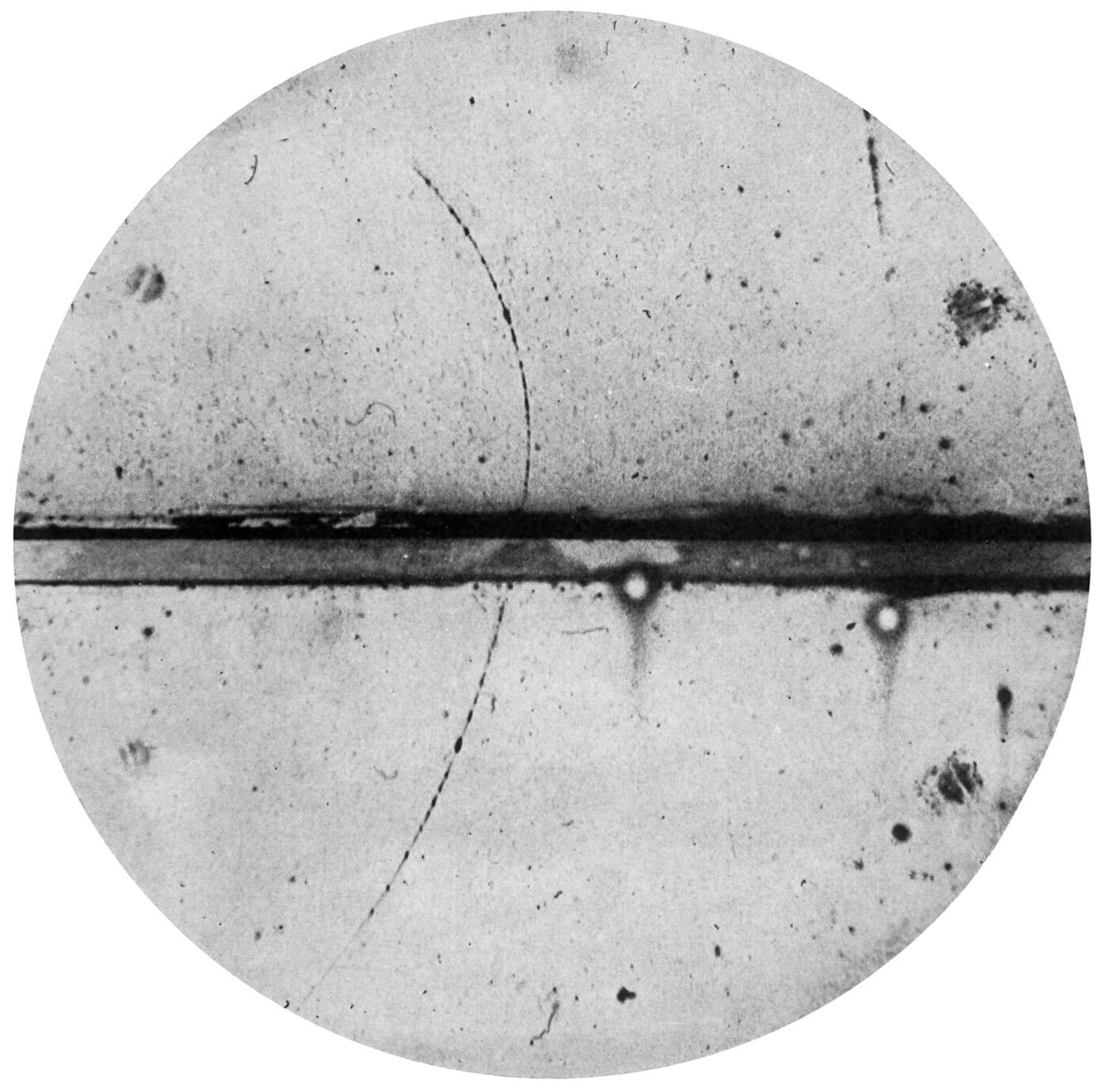
The first positron recognized as one, photographed by Carl Anderson in 1932, as Paul Dirac’s theory had predicted
The first positron recognized as one, photographed by Carl Anderson in 1932, as Paul Dirac’s theory had predictedAnderson, Physical Review 43 (1933)

But a deeper problem arises: gravity may not fit with quantum physics. Quantum theory describes the world of atoms and light, where energy comes in tiny packets. In 1928, the English physicist Paul Dirac found an equation for the electron that obeys both quantum theory and Einstein’s special relativity, the theory of motion at high speeds. Dirac’s theory predicted a new particle, the positron, which the American physicist Carl Anderson found in 1932.

Now the Soviet physicist Matvei Bronstein tries to do the same for gravity, and he finds a problem. Unlike electric and magnetic fields, gravity can’t be measured precisely in a small enough region of space. He concludes that a quantum theory of gravity may call for “the rejection of our ordinary concepts of space and time.”

To this day, physicists have proposed theories that unite quantum physics and general relativity, like string theory, but none has yet passed a test that could have refuted it.

Criticism of #5759 by Matvei Bronstein​·​#5766

General relativity can’t be the whole truth about gravity. Together with quantum theory, it implies that gravity can’t be measured precisely in tiny regions of space. So the smooth spacetime of general relativity must break down there.

The state of the discussion

Newton’s law of gravity still has two pending criticisms. General relativity has a new pending criticism, so it isn’t rationally adoptable anymore, either.

Use arrow keys ← →, the Previous and Next buttons above, or the timeline below to move through the history.Swipe left or right, or use the Previous and Next buttons above or the timeline below, to move through the history.

Sources:

  • Bronstein, “Quantentheorie schwacher Gravitationsfelder”, Physikalische Zeitschrift der Sowjetunion 9 (1936), 140–157
  • Bronstein, “Kvantovanie gravitatsionnykh voln”, Zhurnal eksperimental’noi i teoreticheskoi fiziki 6 (1936), 195–236, quoted from 217–218 as translated in Gorelik, “Matvei Bronstein and quantum gravity: 70th anniversary of the unsolved problem”, Physics-Uspekhi 48 (2005), 1039–1053
  • Dirac, “The Quantum Theory of the Electron”, Proceedings of the Royal Society A 117 (1928), 610–624
  • Anderson, “The Positive Electron”, Physical Review 43 (1933), 491–494

Researched and written with the help of AI, from the sources named. AI can make mistakes. Veritula doesn’t claim perfect historical accuracy; the sources are there to check against.

The full discussion

How Mercury and Starlight Overthrew Newton

Dennis Hackethal started this discussion 2 days ago.

Search​·​Activity

For two centuries, Newton’s law of gravity passed every test but one: a slight drift in Mercury’s orbit. Einstein’s explanation revolutionized our view of space and time.


Discussions can branch out indefinitely. You may need to scroll sideways.
The discussion as it was in 1936. Chronicle discussions are read-only. Jump to the present
Isaac Newton’s avatar
Isaac NewtonHistorical profile​·​#5752​·​July 5, 1687​·​AI-assisted

Every object pulls on every other object. The pull grows with their masses and weakens with the square of the distance between them. This one law explains the orbits of the planets and why things fall on Earth.

Criticized2
Urbain Le Verrier’s avatar
Urbain Le VerrierHistorical profile​·​#5753​·​September 12, 1859​·​AI-assisted

Mercury’s perihelion moves about 38 arcseconds per century more than Newton’s law predicts from the pull of the known planets.

Criticism of #5752
Urbain Le Verrier’s avatar
Urbain Le VerrierHistorical profile​·​#5754​·​September 12, 1859​·​AI-assisted

Newton’s law isn’t wrong. Unseen matter inside Mercury’s orbit, a planet or a ring of small bodies, would explain the difference. That’s how the unseen Neptune explained the odd motion of Uranus.

Criticism of #5753Criticized1
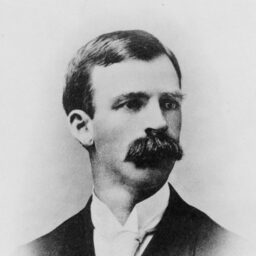
William Wallace Campbell’s avatar
William Wallace CampbellHistorical profile​·​#5755​·​May 1909​·​AI-assisted

Photographs from the eclipses of 1901, 1905, and 1908 show no planet inside Mercury’s orbit big enough to explain its motion. Whatever moves Mercury’s perihelion, it isn’t a planet, or anything else bright enough to photograph.

Criticism of #5754
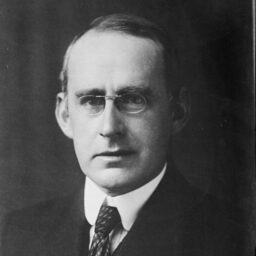
Arthur Stanley Eddington’s avatar
Arthur Stanley EddingtonHistorical profile​·​#5764​·​November 6, 1919​·​AI-assisted

Starlight passing the Sun is bent about twice as much as Newton’s law allows.

Criticism of #5752
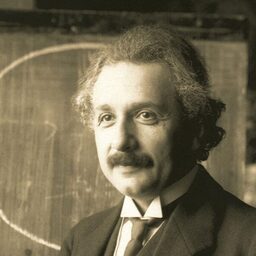
Albert Einstein’s avatar
Albert EinsteinHistorical profile​·​#5759​·​November 18, 1915​·​AI-assisted
2nd of 2 versions

Gravity isn’t a force pulling across empty space. It’s the bending of space and time by matter and energy. Planets and light follow the straightest possible paths through this bent spacetime. Starlight passing the edge of the Sun is bent by about 1.7 arcseconds.

Criticized1
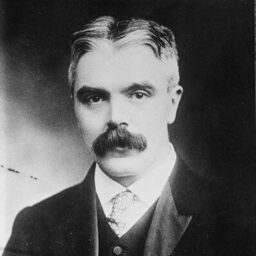
Matvei Bronstein’s avatar
Matvei BronsteinHistorical profile​·​#5766​·​1936​·​AI-assisted

General relativity can’t be the whole truth about gravity. Together with quantum theory, it implies that gravity can’t be measured precisely in tiny regions of space. So the smooth spacetime of general relativity must break down there.

Criticism of #5759
Albert Einstein’s avatar
Albert EinsteinHistorical profile​·​#5761​·​November 18, 1915​·​AI-assisted

General relativity has to explain the extra movement of Mercury’s perihelion, which Newton’s law can’t.

Criticism of #5759Criticized1
Albert Einstein’s avatar
Albert EinsteinHistorical profile​·​#5762​·​November 18, 1915​·​AI-assisted

General relativity explains it. It makes Mercury’s perihelion move 43 arcseconds per century more than Newton’s law does, with no hidden matter needed.

Criticism of #5761
Frank Watson Dyson’s avatar
Frank Watson DysonHistorical profile​·​#5763​·​March 1917​·​AI-assisted

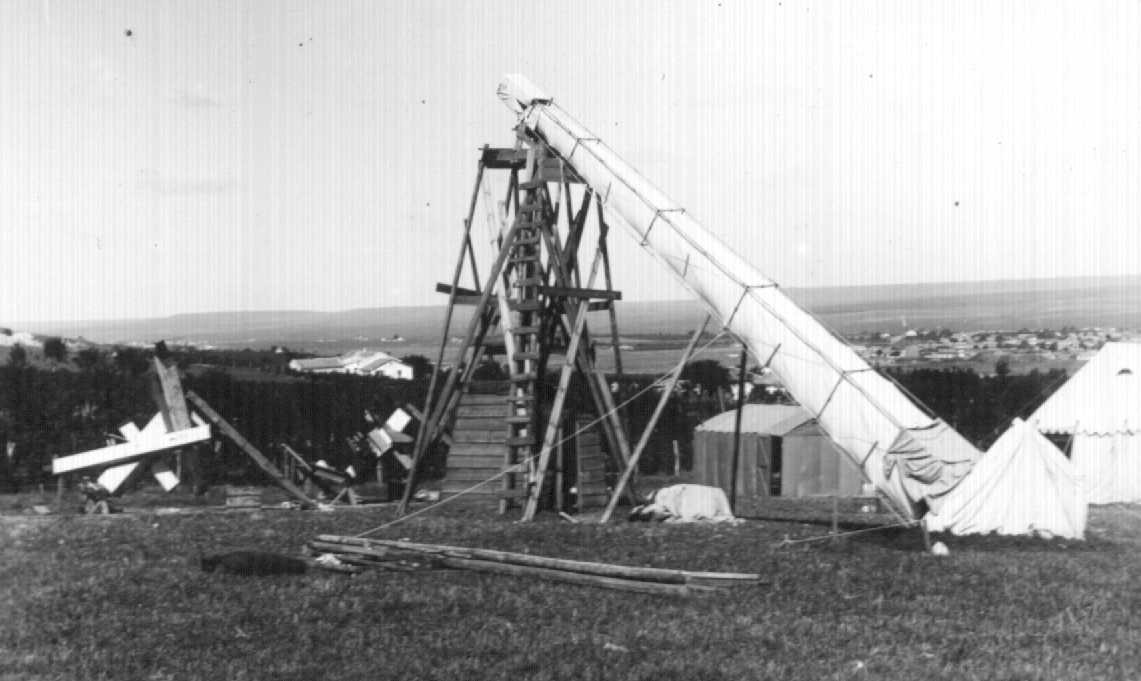
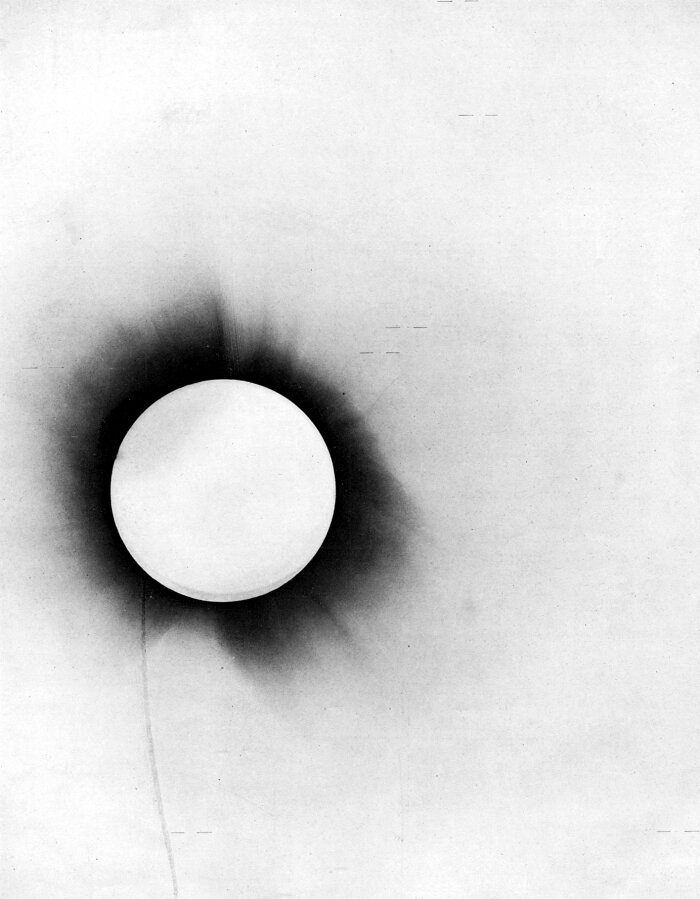
Einstein’s prediction that the Sun bends starlight by 1.7 arcseconds hasn’t been tested yet. The eclipse of May 29, 1919, can test it, since the Sun will be among the many bright stars of the Hyades.

Criticism of #5759Criticized1
Frank Watson Dyson’s avatar
Frank Watson DysonHistorical profile​·​#5765​·​November 6, 1919​·​AI-assisted

The eclipse photos of 1919 show starlight bent by between about 1.6 and 2.0 arcseconds at the edge of the Sun, as general relativity predicts.

Criticism of #5763
  • Rationally adoptable.
  • Not rationally adoptable.
  • Older versions with pending criticisms.
  • Ideas are blue, criticisms red, comments small and gray.
  • Hover over ideas to expand them.
  • Click on ideas to jump to their place in the discussion.