Can One Machine Do It All?
Showing only #5869 and its comments.
See chronicle
The Analytical Engine can’t originate anything. It can do whatever we know how to order it to perform, and follow our reasoning, but it can’t anticipate any truths we haven’t worked out ourselves.
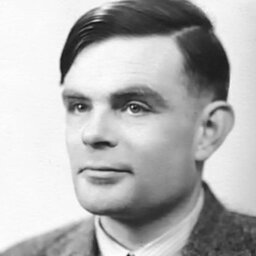
Machines will be able to think. The question “Can machines think?” is too meaningless to deserve discussion as it stands. Ask instead whether a machine can play the imitation game, passing for a person in typed conversation. In about fifty years, computers will play it so well that an average interrogator won’t have more than a 70 percent chance of telling them apart after five minutes of questioning, and one will be able to speak of machines thinking without expecting to be contradicted.
The theological objection: thinking is a function of man’s immortal soul. God has given an immortal soul to every man and woman, but not to any other animal or to machines. So no animal or machine can think.
That restricts the omnipotence of the Almighty. Couldn’t He confer a soul on an elephant, or on a machine, if He saw fit? Besides, theological arguments have often failed before: in Galileo’s time, Bible verses were held to refute Copernicus.
The heads-in-the-sand objection: the consequences of machines thinking would be too dreadful. Let us hope and believe that they can’t.
That’s a hope, not an argument, and it isn’t substantial enough to require refutation. Consolation would be more appropriate.
The mathematical objection: results of mathematical logic, such as Gödel’s theorem, show that every machine has limits. There are questions it will answer wrongly, or not at all, however long it’s given. The human mind has no such limits.
That the human mind has no such limits has only been stated, without any sort of proof. We give wrong answers too often ourselves to be pleased at the machines’ fallibility. And there may be people cleverer than any given machine, but then there may be other machines cleverer again.
The argument from consciousness: a machine would have to feel, not just act. As the English neurosurgeon Geoffrey Jefferson put it in 1949: “Not until a machine can write a sonnet or compose a concerto because of thoughts and emotions felt, and not by the chance fall of symbols, could we agree that machine equals brain.”
Then the only way to be sure that a machine thinks is to be the machine, and the only way to know that a man thinks is to be that man. That’s solipsism. Instead of arguing over it, we have the polite convention that everyone thinks. And if a machine could defend its sonnet’s wording under questioning as well as a person can, I don’t think anyone would call that an easy contrivance.
Arguments from various disabilities: machines may do all you say, but you’ll never make one be kind, have a sense of humor, tell right from wrong, make mistakes, fall in love, enjoy strawberries and cream, learn from experience, or do something really new.
No support is usually offered for these claims. They generalize from the machines people have seen, which are ugly, each built for a narrow purpose, and able to do little else. Many of those limits come from their tiny memories, and computers’ memories are growing.
The argument from continuity in the nervous system: the nervous system isn’t a discrete-state machine. A tiny change in an impulse reaching a neuron can make a large difference to the impulse going out. So a discrete-state machine can’t be expected to mimic it.
A discrete-state machine is different from a continuous one, but in the imitation game, the interrogator can’t take advantage of the difference. A digital computer couldn’t predict exactly what a continuous machine, like a differential analyzer, would answer, but it could give the right sort of answer.
The argument from informality of behavior: no set of rules can say what a person should do in every conceivable circumstance. If people followed a definite set of rules of conduct, they’d be no better than machines. There are no such rules, so people can’t be machines.
That confuses rules of conduct, which we can know and act on, with laws of behavior, the laws of nature that govern our bodies. We can be sure there are no complete rules of conduct, but never that there are no complete laws of behavior: we can never say we’ve searched enough. Even a small program of mine on the Manchester computer can’t be predicted from its replies.
The argument from extra-sensory perception: the statistical evidence for telepathy is overwhelming. In the imitation game, a telepathic person could name the card in the interrogator’s hand far more often than a machine guessing at random, and so be told apart from it.
Then the test needs tightening: put the competitors in a telepathy-proof room.
A machine can be made to learn. Instead of programming it to act like an adult mind, program it like a child’s, and educate it. Its teachers won’t know quite what is going on inside it, so it won’t only do what we know how to order it to do.
Machines take me by surprise with great frequency. To think that nothing new can come from following given rules is to assume that as soon as we know a fact, all its consequences spring to mind at once. They don’t: working them out is real work.

Originating ideas is something brains do, and brains are physical objects. Whatever the laws of physics let a physical object do, a universal computer can be programmed to do. So with the right program, a computer could originate ideas just as people do. What’s missing is the program, not the machine.